
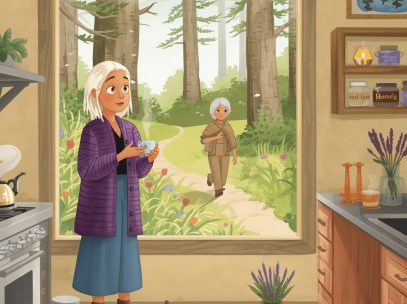
Litha is drinking tea, looking out the window that faces the forest, when she sees that Grandma-René is walking towards her cabin. She feels curious because they usually meet in the reflection spaces, in the common room, or in the wisdom sessions or in the community council but she had never come to her cabin
She opens the door for her and greets her:
"Good morning, René. What a surprise to see you. Is everything okay?" —asks Litha.
"Hello, Litha. I've come to see if you have time to help me get clarity on what's happening in the dining hall," —says René.
"Come in," —says Litha.
René enters the cabin and Litha puts water on to heat for tea, lights a candle, takes out a couple of cups, milk, sugar, honey, and several jars with tea blends. René sits in one of the kitchen chairs and begins to tell:
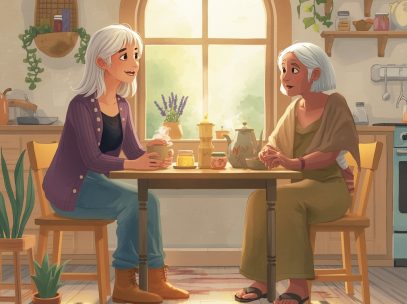 "A few days ago I went to the dining hall and saw that there are different schedules and food options than what we've always had. I felt confused, I didn't remember that we had made such a change," —says René while choosing a type of tea—. "When I asked, they told me that we had indeed made that change, that you brought that motion to the community council and we agreed to it. Can you remind me how it was?" —she asks Litha while taking the jar of sugar.
"Of course, René. I imagine it was very confusing for you to see the changes in the dining hall and not remember where they came from, right? I'll tell you so you can have more clarity," —she says while putting honey in her teacup—. "It's been a couple of months since we talked about the care and consideration of each person. The different ways to process were presented at the community meeting, do you remember?" —Litha pauses.
"I remember the topic of the different ways to process and that we would have considerations, but what does that have to do with the schedules and food options?" —asks René.
Litha finishes taking a sip of her tea and responds:
"The considerations for processing are not just about giving time to process situations and thoughts; it also includes the way we process food," —says Litha while adding a little milk to her tea and continues—. "Creating the space and conditions to take care of digestion is part of it. Some need small portions to eat while doing an activity, others need calm spaces to sit with their hot food, others eat in silence, others eat while sharing ideas..."
"Oh, no, Litha, that's too complicated. We already have a nutrition plan that applies to everyone: three meals a day and two snacks. That was the nutritionist's recommendation, and each meal is balanced according to what he told us. If we change to what you are proposing, we are deviating from what we know works for everyone," —says René.
"I imagine it's important for you to know that everyone is nourished, right?" —asks Litha.
"Yes, and that it's simple for everyone. Everyone together for the three meals, in the same place, eating the same thing, as it has always been done," —assures René.
"I hear that simplicity is also important to you and... does keeping things as they were give you security?" —inquires Litha.
"It's not security, it's certainty. Three meals a day apply to everyone, the nutritionist said so, and it has worked that way for over 50 years," —affirmed René.
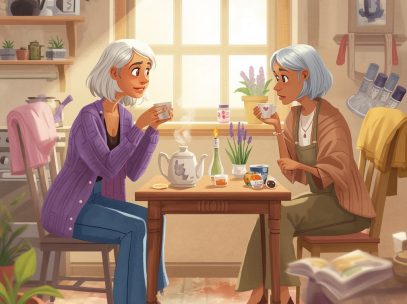 "Keeping what works is important, of course. And at the same time, René, I want to return to the need for nutrition that was presented at the community meeting," —said Litha while bringing the cup to her heart—. "Some of us have presented situations of discomfort, which include malnutrition, sleep changes, memory problems, and not just adults: also several children," —Litha sighs with concern—. "That's why I was asked to bring the topic to a community meeting to find strategies that take care of everyone," —Litha finishes.
"The three meals take care of everyone. They have worked for everyone within the community until now," —responds René, placing her cup on the table—. "Perhaps the people who have presented discomfort can eat in their homes and not in the common dining hall. That way we maintain three meals a day with what the nutritionist recommended.".
"Oh, René, would you like to keep the meals in the dining hall as they were? Did you highly value the space where there is a structure that gives you security, and would you like to preserve this because it gives you certainty and confidence that everyone will be okay?" —reflecs Litha with empathy.
—Yes, I would like to keep things as they are. I am afraid that the changes will make us no longer function as a community —says René, sighing—. What hope can we give to others if we stop functioning as we have until now? —finishes René, now with concern.
 —René, I hear there is great fear. A squeeze reaches my heart, like a grieving process in which one still wants to negotiate because the changes are so great that we fear for safety. Is that so? —asks Litha.
René abruptly cuts off the conversation saying—I'm clear about the dining room now. Thank you for your time, Litha. I believe we need to go back to the three-meal version, and I don't know how to do it now that the change has already been approved… I'll think about it. Thanks for the tea, I'm leaving now —said René, standing up from the table.
As soon as she left, Litha leaned back in the armchair with a heavy heart.
She was taking some deep breaths when Eture, the fairy of emotions, landed next to her hand.
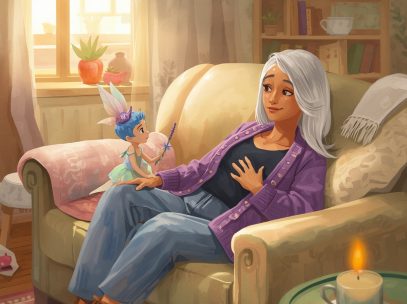 —Hello, Eture. You feel the turmoil in my emotions, right? On the one hand, I feel regret that René is experiencing such a deep grieving process. I would like to accompany her and, at the same time, I want to respect her times and spaces, because that is precisely the individual consideration we are seeking with the change. I also feel frustration because I would like to be able to share the vision that evolving is part of life. I also notice a tiredness in me: seeing things that other Abues don't see and trying to explain it is exhausting —Litha tells Eture.
—For you, community, diversity, and inclusion are as important as peace and sustainability, right? —empathizes Eture.
—That's right. I believe that the ability to create a diverse and inclusive community goes hand in hand with embracing those parts of our history that cause us fear —sighs Litha.
—The fear of dying is the most painful human experience when lived from loneliness, isn't it? You know that firsthand, Litha.
 —Yes, I know… —says Litha as she hugs herself and strokes her arms—. That's why, all the more reason, I wish René knew that she is not alone, that we are all united in this… —says Litha after a couple of breaths.
—And as the Projector that you are, you will wait for her to take the first step, right? —says Eture with complicity.
—That's right… as a Projector I know that I contribute when I wait to be invited to give my opinion, just as happened in the community meeting —continues Litha in a tone of complicity.
—You are doing an excellent job, Litha. We are very proud of you. We see your love for life and your connection. Your community knows it too, for a reason you ARE an Abue —says Eture, rubbing Litha's hand.
Litha smiles and is filled with joy. Now she feels connected again, remembering her mission, her gifts, and that she is not alone. There are so many in the community recognizing the importance of evolution, diversity, and inclusion. If it weren't so, these changes would not be happening. Trust, connect, and let go are the three words that come to her mind.
“You do your part, Litha. The rest is in the hands of the universe”
Every personal experience is an expression of the divine evolution of love. Every feeling and every need met builds our human experience. We are all in this experience together, and living it accompanied nourishes us all. Do you have any grief that you would like to experience accompanied by the loving presence of Abue-Litha?